


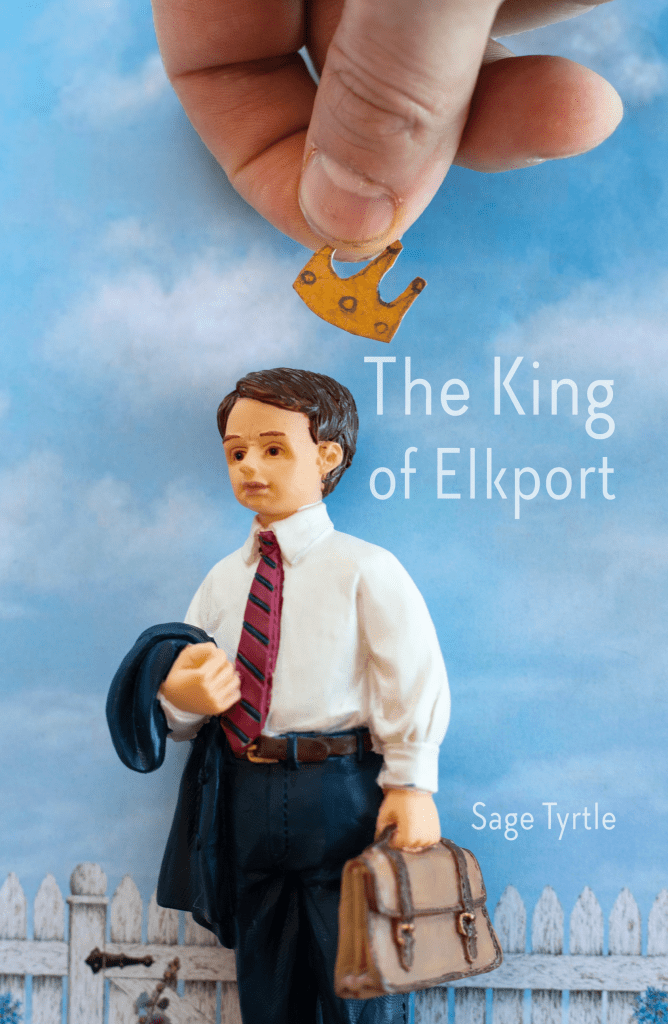
I invited Sage Tyrtle to talk about “The King of Elkport” , to tell us a bit about the inspiration behind it, what readers should expect, and any similar books that we have read. Here’s what Sage wrote-in for the Guest Blogpost:
The inspiration for this book came from thinking about the way rich people spend their money. Like it’s license to play at being a god. Building a replica of the Titanic. Paying a celebrity to spend the day with them. Funding a huge charity for their kid to work at just so they can talk about it in their Ivy League university application.
And I thought, what if a billionaire wanted to travel through time?
What’s the closest they could get? Elkport was the answer. And once I
started writing about tech billionaire David Walker’s life, I wanted to
talk about a subject I rarely see in fiction – men and loneliness. I
read that during the lock down a lot of men found themselves very
lonely, without the public places they were used to attending with
their friends. That that kind of spending time together didn’t translate
to online video calls. I mean, how does anyone make friends in their
fifties? David Walker’s solution may surprise you.
What should you expect from The King of Elkport? If you like near
future speculative fiction, if you like Groundhog Day, if you’re
curious about a novella that answers the question, “Is there really a
cure for loneliness?” this is the story for you.
Book trailer and Buy link here
“Unsettling, disturbing and illuminating in equal measure, as we realise where things went wrong in Davy’s past life. The King of Elkport reminds us, with crisp characterisation, unselfconscious world-building and sparkling devastating effect, is that you can go home again, but you take yourself there too.”—Electra Rhodes (BBC, Writing Rules)
MONTHLY BLOGPOST
Centre of an Imaginary World: Love Affair with Place in Fiction Writing
Recently, it came as a surprise how many of my stories were based in the culture and climate markers of the place I live in. If not by explicit mention geographically, they certainly wore badges of a common identifiable whereabouts. I realized it was the center of my imaginative world, just like for novelist Amitav Ghosh it is Calcutta, and in the same way James Joyce records his short stories upon the scaffolding of the city of Dublin:
In Westmoreland Street the footpaths were crowded with young men and women returning from business, and ragged urchins ran here and there yelling out the names of the evening editions… full of the noises of tram gongs and swishing trolleys and his nose already sniffed the curling fumes of punch. — “Counterpart”
Consider the accurate sketch of Dublin, the stage is the city’s pavements: urban working class on the throes of change are characters, drama in a state of flux. Compare the above with a similar passage from “The Shadow Lines”:
“…he was a familiar figure within the floating, talkative population of students and would-be footballers and bank clerks and small-time politicos and all the rest who gravitated towards that conversation-loving stretch of road between Gariahat and Gole Park.”
It is in the appreciation of this, that I proceeded to examine the importance of place in fiction-writing and how work needs to be seen through the prism of the cities themselves. Simultaneously, it intrigues me why fiction should be strongly rooted in place anyway? Accomplished writers deftly use cities and hometowns, like wefts and warps, looped into their writing. The chosen locales, then, lend themselves to superlative imagery and metaphors, becoming the fabric on which character nuances are weaved in, almost like rich tapestry. Authors use the place’s dramatic historical upheavals, and even mundane daily affairs. Remember Ray Bradbury’s “Dandelion Wine”?
In perusal of writing, drawn so much in context and reference from places that flow in the veins of writers, I find that we’re in love with them, like soil before a seed takes root.
Now, returning to why I write the way I do, I unearth from memory what may have something to do with it. Sprawled under the Jamun tree in my grandfather’s farmyard, I once considered a fallacy. What if all I saw was falsehood, make-belief: the pillared courtyard of the house, to indulge me like a child’s doll house; the ripened paddy fields just around the house’s periphery, just ochre abundant lies; the neighbor’s mango orchard, like an open notebook of fluttering green leaves. What if the halcyons had oars, the lily ponds hid spluttering cheeky young imps, the sky had shelves where I could store my jars of berry pickles or the colors of that rolling sunny afternoon. I wondered then if ‘un-centered center’ was the best way to describe this eternal swirl of muddled thoughts in my adolescent brain, just as I wonder now if the neon-lights I see beyond my writing desk, signages to guide them to that epicenter.
I realize writing should be tethered to roots, and place, to ooze both authority and authenticity. To fall back on origins and identity to build imaginary worlds seems natural. For example, I can easily recall the fragrance of rain-washed black soil, the bounty of nature as much as its ferocity, the warmth of a neighborhood where you knew what was cooking in the other’s kitchen, quite literally, and write about those. I can effortlessly visualize childhood summer fairs, cobbled lanes, cattle sheds, and the weekly marketplace: these are some recurring themes and images in my narratives. I hope to project these images like a series of frames, together with the unique sounds and experiences, through my work.
It’s no surprise then that writers will make tiny appertures out into the places that are centers of their creative minds, and readers can glimpse a new undiscovered world. This sort of place-centric approach piques the reader’s interest in general, and helps to emphasize both character and plot.
[FIRST PUBLISHED IN CLEAVER MAGAZINE, AUGUST 2022]
PROMPTS
DIFFICULTY LEVEL 1: Unearth a particular childhood memory where you discovered an object or tool and how it works. Blend the narrative with the description of the place you were in at that time.
DIFFICULTY LEVEL 2: We travel and move houses many times as we grow-up. Any place where you went and immediately said to yourself that you wanted to live there forever. Write a story in which the future you celebrates the wish fulfilment OR complains that it was never fulfilled.
DIFFICULTY LEVEL 3: Re-write a fairy-tale or witch story or folklore using the setting of your current place of residence.
SUBMISSION SPOTLIGHT:
Here I list magazines & submission windows writers may not know about.
These are FREE TO SUBMIT and OPEN on JUNE 1
Baffling Magazine (June 1 – 15 flash fiction), Lost Balloon (June 1 -7), Epistemic Literary (Food themed), Livina Press (all genres), The Horror Tree (scifi & speculative), JOYLAND (free for Black writers), Whale Road Review (June 1- 15),
WORKSHOP NEWS
An online generative flash fiction writing workshop plus Craft Talk organized by The Flash Cabin
ABOUT THE WORKSHOP
Let’s look at the science of flash fiction writing. What is the psychology behind an effective opening paragraph? What is the de rigueur technique of a short-short’s structure? How can geometric shapes inspire flash writing? And how to use & ‘Time’ in flash fiction? We’ll discuss these alongside the ‘art’ of writing brief. We’ll throw in generative prompts in-between the discussions, in a sort of mixed styling that keeps attention levels high. These prompts will challenge the flow of thoughts and imagination of participants. Attendees can look forward to three new drafts, and numerous adjacent ideas. We’ll read out and/or link-up to examples wherever available. In the last ten minutes we’ll read drafts, and bounce new ideas around for peer feedback.

DATE Saturday, June 10th
TIME 14:00 – 16:00 GMT
COST Pay what you can £0, £5, £10, £20
FORMAT Live Zoom session
WRITING-TIP OF THE MONTH
When entering into a contract for a piece of writing, take your time and make sure to read carefully. Ensure that you agree with each and every clause. That’ll help in the long run. If one or more terms do not suit you, don’t shy away to reach out to the Editor/Publisher to clarify. The publication is usually more than happy to address your concerns. If that is not an option you’d like to exercise, it is always okay to seek advice from people you trust. Reach out to fellow writers. Speaking to them might help discover new problem areas and you’ll learn from their experiences. Most writers are eager to supply you with information that’ll help you. Don’t hesitate and repent later.
About this blog
Last day of the month, I post craft essays ruminating on writing life and craft, highlighting stories on a particular chosen theme, prompts for Beginners/Intermediate/Experienced writers, Pro-level tips and selected free submission opportunities.

