
Special Blogpost for National Poetry Month
As you may remember, for my last blogpost I had shared my special Poetry Month trampset column What Do Fiction Writers Do All through Poetry Month? I hope you enjoyed the list, and especially, if you are a fiction writer, I hope you’ve been inspired by item #10
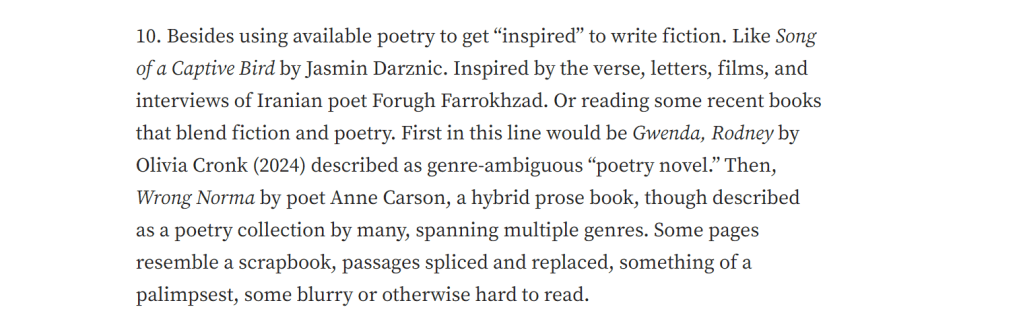
Check out the column again. In it, I had referred to a poetry piece at list item #6, titled “Home Economics” by Chae(lee) Dalton.

In today’s craft essay, we will explore the steps to write fiction “inspired” by poetry using this specific poem “Home Economics” as an example.
Step 1
Let us first enumerate our initial observations on reading this poem:
- All stanzas start with the word “consider”.
- Pop culture references abound–KBBQ, KPop, KDramas etc.
- Use of Economics terminology and concepts–Gross Domestic Product, market, exports
- Use of historical references–Japan renamed Corea during its occupation, colonizers
- Personal reference points– adoption, mother at work, buying groceries
- Themes of loss, grief, displacement, historical injustices
Step 2
Let us break down each of these.
- All stanzas start with the word “consider”.
When a sentence starts with “Consider…”, it’s usually an invitation (or instruction) to think about something carefully—often to introduce an example, idea, or scenario. It’s a way of directing the reader’s or listener’s attention to a specific point for reflection or analysis. So, “consider” is often used to:
- Prompt thinking or reflection
- Introduce a hypothetical or example
- Support an argument or explanation
It can sound formal or thoughtful, depending on the context, but it is immensely effective. In the sentence “Consider the market,” the speaker is urging the listener (or reader) to think carefully about the market—now market could be anything: a local market, animal market, the stock market, or even a slave market. It could mean urging the reader to visualize a market. Think about how a market behaves or is performing currently. Think about current market conditions. Or, simply to take the market into account before making a decision. So, it’s kind of a thoughtful nudge—like saying, “Hey, don’t forget to factor this in.”
This sort of appeal “to consider” something is a fine structural tool equally effective in fiction, especially flash fiction. One can write a story where all sentences (or paragraphs) begin with the word “consider” enumerating a list of circumstances or situations that give rise to the finality.
Prompt Exercise 1:
Not only the plea to “consider something”, which is just another way of saying that you should pay attention to something, we may simply begin to “construct” a story using the same word or clause repeatedly. Try starting every sentence in the story with “After the apocalypse…”, and imagine the rest of the scenario.
2. Pop culture references abound–KBBQ, KPop, KDramas etc.
Pop culture references like KBBQ, KPop, KDramas, etc., help to anchor a story in a specific cultural moment or vibe. They’re like shortcuts that immediately convey mood, setting, or even timeline without having to explain everything from scratch. Pop culture references can make a story feel more global (like nodding to Korean cultural exports that have gone worldwide), or more local (if you’re highlighting how these elements show up in specific communities or cities).

Prompt Exercise 2:
Write a story using pop culture references from your region. Keep in mind that they should be local enough to lend your voice authenticity and global enough for universal readership.
3. Use of Economics terminology and concepts–Gross Domestic Product, market, exports
Using subject-specific terminology and concepts from any field (like economics, science, law, art, music etc.) can seriously enhance fiction through grounding a story in realism, tension, or context. For example, jargon from biology, AI, physics, medicine—if used well—makes speculative or sci-fi stories more immersive. Think: Hard sci-fi like The Martian, where botany and engineering terms aren’t just filler—they’re how the character survives. Musical terms like allegro, cadence, crescendo are frequently used in fiction for various effects—poetic, symbolic, thematic, or even structural. Writers borrow these terms to add rhythm, evoke emotion, or draw parallels between music and storytelling.
Prompt Exercise 3
Fugue is a musical term. It might describe a complex narrative structure or a mental state (like a fugue state) in a work of literature. Write a story using “fugue” in the title. (Use other terms from music like “tempo”, “harmony”, “melody” and “resonance”). For inspiration, read 2024’s Best Flash Fiction: And why I love them (a curated year-end list that I do every year) that has a piece titled “Analysis of a Fugue” at #3.
4. Use of historical references–Japan renamed Corea during its occupation, colonizers
Whether you’re writing historical fiction or just seasoning your story with historical allusions, this tool is highly effective. Scores of writers use local and global historical references to invoke a particular period or event, and set the story with the right amount of tragedy and remembrance without using as many words. However, it is important to research well, and use the historical event or person in the correct context.
Prompt Exercise 4
Oscar-winning movie “The Reader” is based on a novel, but the production team toured locations from the novel as much as they viewed documentaries about WW-II period and German history and read books and articles about women who had served as SS guards in the camps. All this is to highlight the amount of hardwork that goes into research before a historically accurate reference can be made in a work of fiction, in a film or a novel. I hope you’ll attempt to write a story about a woman in Hiroshima who survived the 1945 bombing and include as many historical references as you may find.

5. Personal reference points– adoption, mother at work, buying groceries
Using personal reference points in fiction is like planting emotional anchors—they make your story more authentic, relatable, and rich in lived experience. Whether it’s something big like adoption or subtle like how your mom always hummed while cooking, these details can give your fiction heart and texture. Start by identifying moments, relationships, or observations from your own life that still resonate emotionally—then reshape them. Ask yourself: Why did this moment stay with me? What does it say about being human? The goal isn’t to retell your life—it’s to extract the emotional truth and translate it into something readers connect with.
Prompt Exercise 5
Personal reference points give you access to rich sensory details—how a childhood home smelled, what a worn grocery list looked like in your mom’s handwriting, the sound of the subway at dusk. Use as many as you remember about a childhood trip to the market in a fictional account. My story in UK National Flash Fiction Day Flash Flood 2023 MARCH GOES TO THE MARKET might help!
6. Themes of loss, grief, displacement, historical injustice
Using heavy themes like loss, grief, displacement, and historical injustice requires a delicate mix of emotional truth, respect, and narrative craft. These aren’t just dramatic topics—they’re powerful tools to connect readers to deeper human experiences. Loss isn’t always about death—it can be the loss of innocence, home, identity, dreams. Grief is how that loss echoes. Similarly, for displacement–it can be a shift in what our mind assumes to be true just as it can be about physical displacement. The crux lies in avoiding cliches and being truthful. Lived experiences always shine brighter.
Prompt Exercise 6:
Grief and memory aren’t linear—neither is trauma. In a fractured or non-chronological piece, show the reader what it means to revisit a place you were only briefly-in in your childhood, and what event forever cemented that memory in your mind.
Step 3
Mix and match the points listed in Step 2 to create a layered, complex response to the poem.

Step 4
Once a draft is ready, remember to personalize it even more. Be creative and be honest with yourself. Finally edit it to perfection!
I hope you enjoyed this craft essay. Let me know in the comments.
If you haven't subscribed yet, don't forget to subscribe below. Share with your writer friends. Click here for more craft essays like this. Thank you!