
Hello September!
good news stories
We’re in the final one-third of 2026. That’s good news enough I guess–given the turbulences this year has already seen.
In the litmag arena, not all good either with the influx of AI-generated writing and many venues moving to fee-based from being fee-free. Windows close too early too. If a publication opens on August 15, you’re too late if you think of submitting on the 22nd–that’s how saturated it has become. Anyway, we must keep doing what we can, and that is: write and submit.
One of the good news stories this month is books that made a splash. Chicago Review of Books published a list of 12 Must-Read Books of August 2026. Notable inclusions are “Guapa” and “Sunrise”.
The Jaipur Literature Festival (JLF) organizes international editions. JLF USA and JLF Toronto will run from September 11 to October 4 across North Carolina, Los Angeles, Seattle, Colorado, Toronto, New York and Houston, marking the festival’s largest presence yet in North America.
Many writers have written to me if reading for a magazine increases chances of acceptance and success in online publishing markets. Answer is: 100%. Good news is that magazines advertise open positions from time to time. You may follow their social media for information. As of August 29, 2026, West Trade Review happens to be seeking a volunteer Associate Poetry Editor and a volunteer Associate Prose Editor. I’ve worked with WTR for this piece and enjoyed the experience.
Also as of the same date, Rawhead: A Journal of Art and Literature is seeking a volunteer Managing Editor, volunteer Grants and Fundraising Manager, volunteer Social Media Manager, volunteer Social Media Assistants, and volunteer Readers.
what are writers talking about?
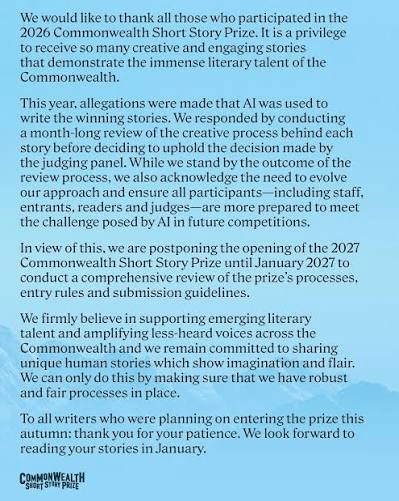
An update on the 2027 Commonwealth Short Story Prize was announced on August 12.
Following the postponement, participating writers have been talking about this. News media framed the delay as structural “fallout”. An article by The Indian Express (August 14) emphasized how the scandal expanded past the overall winner, Jamir Nazir, to engulf other regional winners like Maltese writer John Edward DeMicoli and Indian-origin writer Sharon Aruparayil. The press noted that the postponement leaves global majority writers in an uncomfortable limbo, as the prize attempts to draft entry guidelines that can police AI without unfairly penalizing or scrutinizing marginalized human voices.
Personally, I welcome the decision of the CWP organizers. Coincidentally, less than a week earlier, on August 06, LitMagNews published an article of mine titled “What the Commonwealth Short Story Prize Controversy Means to Commonwealth Writers”. I’d like to believe that the facts, figures and opinion expressed in the article may have had some influence on the postponement decision.
AAWW went on a Sudden Hiatus. WHY?
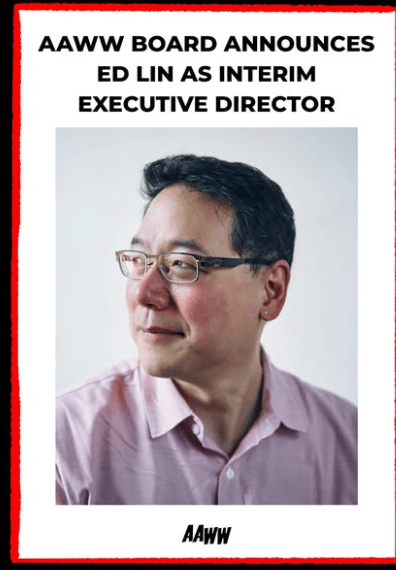
On August 12, I, alongside many submitters, received an unfortunate email. Our “In-progress” submissions were being turned back as Asian American Writers Workshop (AAWW) shared that they were going on “indefinite hiatus”. As announced on social media, AAWW entered a pause and shifted to a temporary all-volunteer structure in August 2026, following the departure of Executive Director Jafreen Uddin. Read AAWW’s statement HERE & HERE.
The AAWW shared it will pause major programming until further notice. In anticipation of logistical needs in the near future, the Workshop will be looking for volunteers for various capacities.
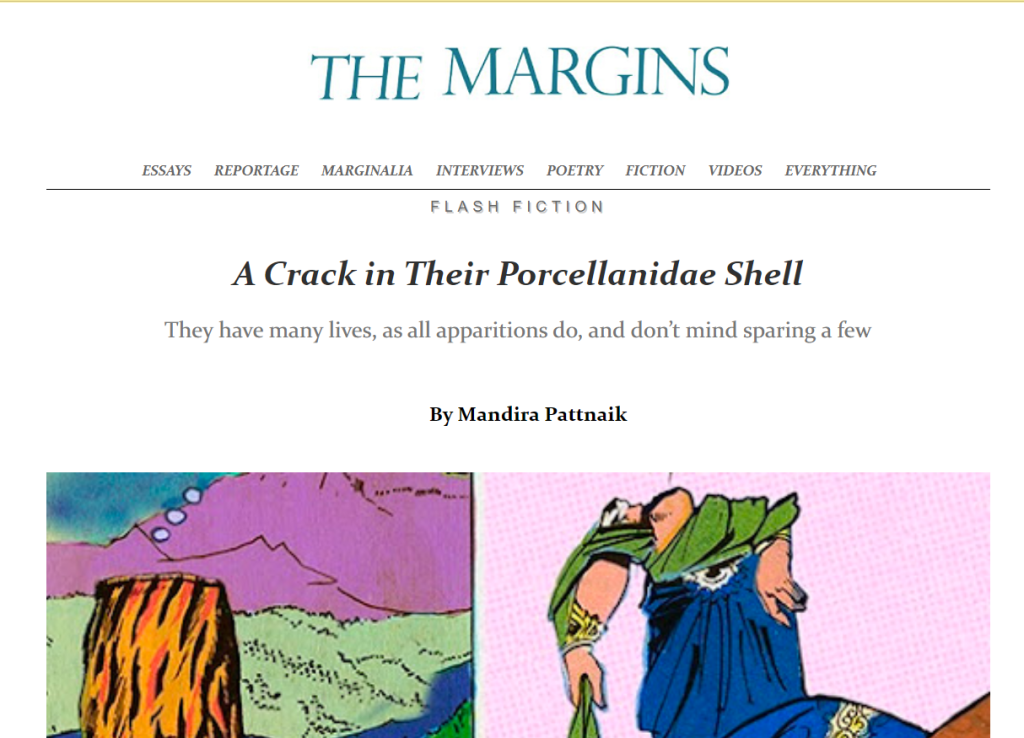
Earlier, in December of 2022, AAWW had published this piece of mine “A Crack in Their Porcellanidae Shell”.
selected Submission opportunities
Deviating from my usual curated listings of paying + no fee opportunities, for a change, this month I’m listing TEN no-pay + fee-free magazines that ALSO have high submission acceptance rates:
[Please keep in mind: Acceptance rate data may be erratic and unreliable, fluctuating across community tracking platforms such as Duotrope and ChillSubs, and as reported for time of the year (Summers happen to be slower).]
Acceptance rate for Bright Flash Literary Review is approximately 15%. They published my flash fiction “A Cat and a Mouse Game” in 2021.
Eunoia Review: The acceptance rate for Eunoia Review ranges roughly from 22%-37%. Fast turnaround, often within 24-hours.
CommuterLit.com is published and edited in Toronto, Canada, by award-winning writer and editor Nancy Kay Clark. It has been around since 2010. CommuterLit magazine has an acceptance rate of roughly 24% (Duotrope) to 48% (ChillSubs). Submissions always open. They have published me twice. “Qui Will Never Move to Quanzhou” is one of them.
The acceptance rate for Cosmic Daffodil Journal is roughly 13.5% (Duotrope) to 20% (ChillSubs). The venue was established in 2022. They have faster response time than most magazines.
Founded in 2012 by Alisa Golden, according to their submissions page, at Star 82 Review, acceptance rates are 8 % to 10%. I was published in Issue 8.2 of *82 Review back in 2020! READ here.
50-Word Stories publishes only 50-word stories. They read submissions every month between the 1st and the 15th. Around 30% of what is submitted to them reach publication according to Authors Publish. Published some of my earliest micros, one of which is “Small Town Surmises“.
Speculative military fiction that is sensitive to the complexity and tragedy of warfare is welcome at Bullet Points. As per Authors Publish, they accept around 25% of all submissions.
Back in April 2021, the title poem of my debut poetry chapbook “Anatomy of a Storm-Weathered Quaint Town” was published in Eclectica Magazine. Read the poem HERE. Eclectica Magazine has an estimated acceptance rate around 20%.
365 Tomorrows has had a consistently high acceptance rate, and many speculative authors started here. According to their site, “Definitions of flash-fiction vary depending on who you ask, and at 365, we’ve been a little loose with the term. However, it’s time to set some standards in stone: here, flash fiction is a self-contained story under 600 words … We like science fiction in all its incarnations, from hard sci-fi to cyberpunk and beyond.” Find their full guidelines and their submission system here. Again, I’ve two pieces in its archives. This is one of them, published in 2019. Oh, eons ago, it seems!
Finally, check out BLINK-INK. Reopening September 1st. Beautiful print booklet. They’ve shipped contributor copies all the way to me, even remembering to insert a pretty bookmark. Blink-Ink has an estimated acceptance rate ranging 11-22%
And, of course, there are hundreds more at For Writers: 10 Easily Usable and FREE Sites to Find Submission Calls in 2026
How much is too much Reading Fees?
Online literary community shared opinions over the news that reading fees are steadily rising. Gone Lawn Journal said: “At least include an option for challenged writers and/or offer free reading periods, if one must charge the author. But really, how many writers can afford hundreds of bucks for rejection after rejection?”
Writers shared that they often stick to a limit of paying USD 3/4/5 PER SUBMISSION, and never more than that, which I think is a great strategy. Some have set a monthly limit for themselves.
What do you think is the best strategy? Share your thoughts in the comments.
opinion: Leader of Opposition in the Indian Parliament Said Mobile Phone is a 21st century cage
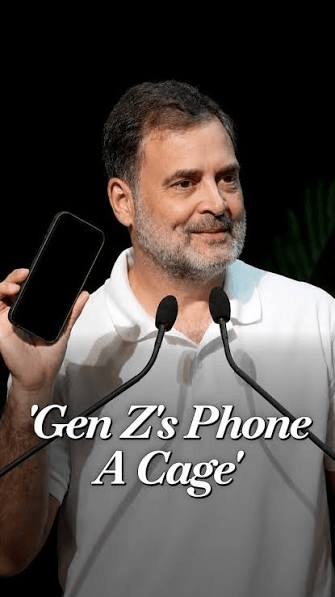
I’ve written couple of articles around the addictive nature of social media, and how it ruins my writing time. “Reclaiming Writing Life By Staying Off Social Media: Is it Doable?” (July 2025) being one of them. I’m glad someone of the stature of Rahul Gandhi fearlessly said that the mobile phone is a 21st century cage, even though it has its uses. I agree about the uses, but they are the most basic uses, unrelated to doomscrolling on social media. I’m aware that most of the population believes otherwise. Many writers spend a considerable amount of time on SM, and later, regret it. What is your opinion?
I’m looking forward to hearing from you!
recommended reading
Ray Bradbury’s “There Will Come Soft Rains”. While originally published in 1950, it has re-entered critical spotlight because its precise fictional setting—August 4, 2026—finally crossed paths with the real calendar. Critics and readers analyzed how the text has transitioned from far-off science fiction into a chilling, mirror-like reflection of today’s world. The narrative takes place entirely inside a highly automated “smart home” in Allendale, California. The house functions flawlessly: it cooks breakfast, cleans, prepares cocktails, and recites poetry. However, the human inhabitants are completely missing. In a sudden nuclear blast, the family was vaporized, leaving nothing behind but their charred silhouettes seared onto the outer west wall of the building. Roger Ebert notes how the story’s “smart home” is an exceptionally prescient look at our modern obsession with Artificial Intelligence, automation, etc.
Originally published by The Wire on July 22, 2026, and subsequently featured across international platforms like The Walrus and Progressive International in August, Arundhati Roy’s essay “Cockroach Democracy: Unarmed and Dangerous” about the youth-led student protests in India, is my recommendation for nonfiction.
In flash fiction, “iron & garlic & salt & blood” by Nico Martinez Nocito. This is an experimentally structured piece that stretches form. Published in the August 2026 issue of Flash Fiction Online.
publications!
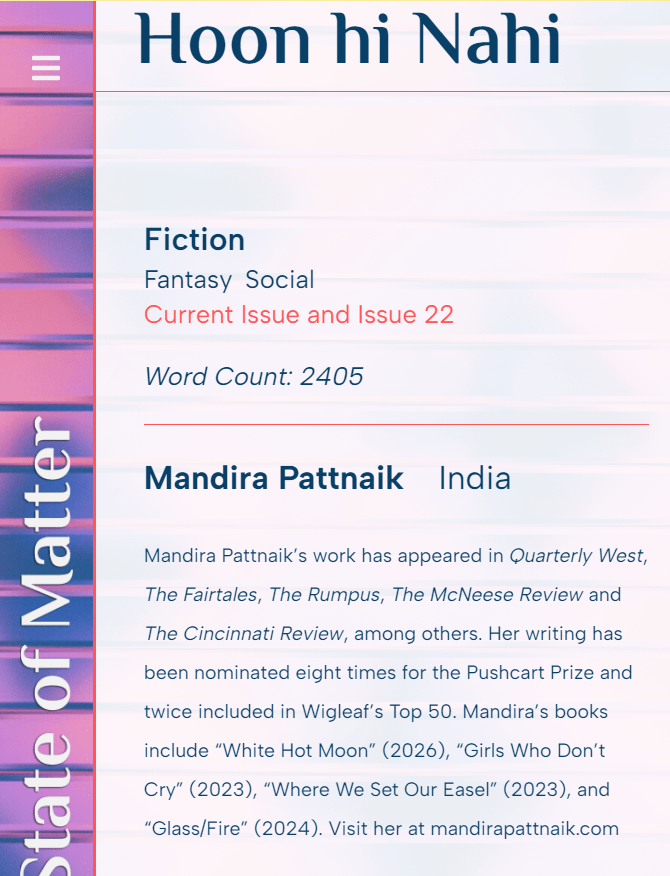
Fantasy fiction in Indian speculative magazine State of Matter on August 22. Titled “Hoon hi Nahi“, short for the longer “Hoon hi Nahi is Duniya Ki”, it alludes to rebellion against societal norms of the world (Duniya). Set amidst a conflict between the “clan of clouds” and those on earth, the story was accepted by Nassau Review (Nassau Community College) in 2023, but never published due to funding issues.
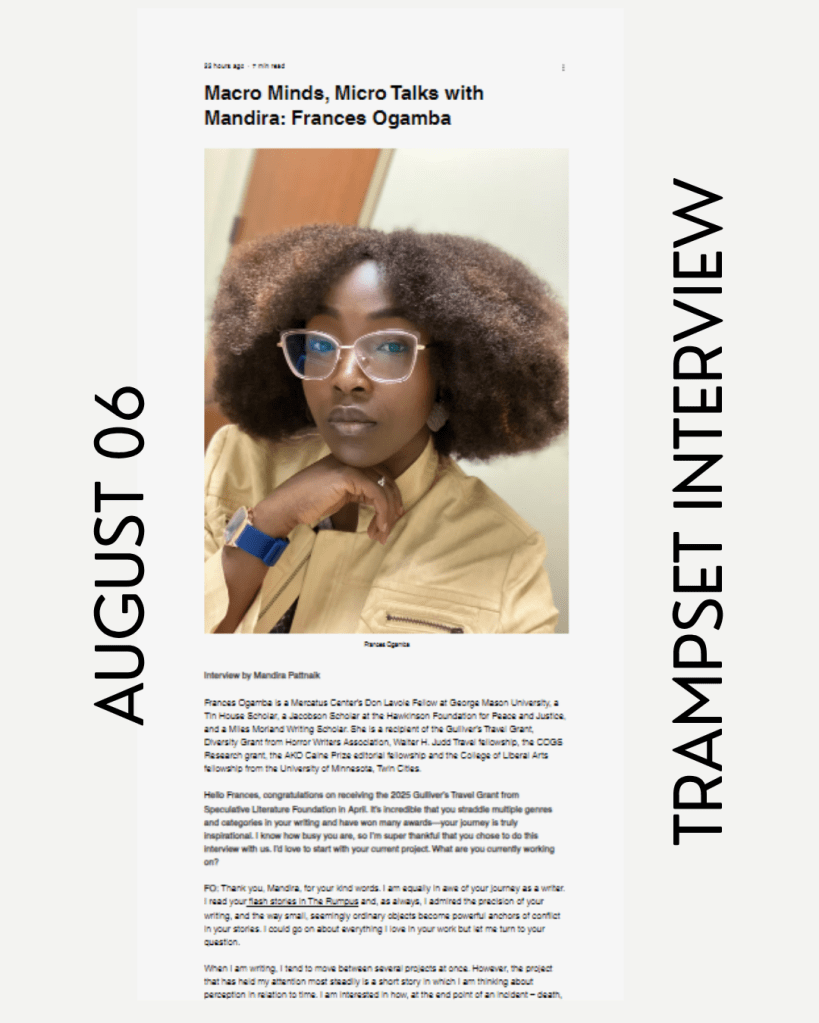
In my interview series for trampset, “Macro Minds, Micro Talks”, I interviewed writer Frances Ogamba in August. The chat was really candid and also inspiring. I’m happy that we can relate and learn so much from other writers’ process and perspectives. READ HERE.
Frances says:
“In the story, what comes after intimates what came before. A disembodied narrative voice re-examines the near-misses and the entirely missed signals that continually dissolve into the steam of the present. It is afterwards, rather than beforehand, that we begin to make sense of all the information the universe may have been relaying to our bodies and minds while events were still unfolding.”
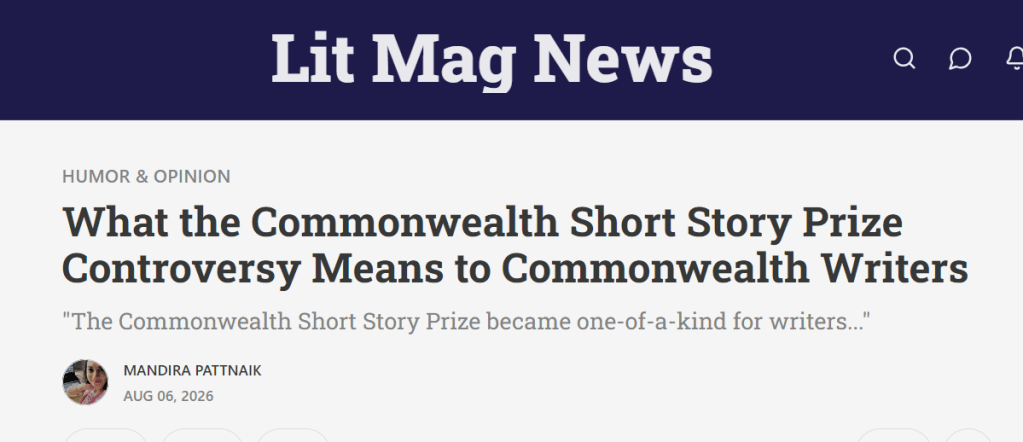
On August 06, LitMagNews published an article of mine titled “What the Commonwealth Short Story Prize Controversy Means to Commonwealth Writers”.
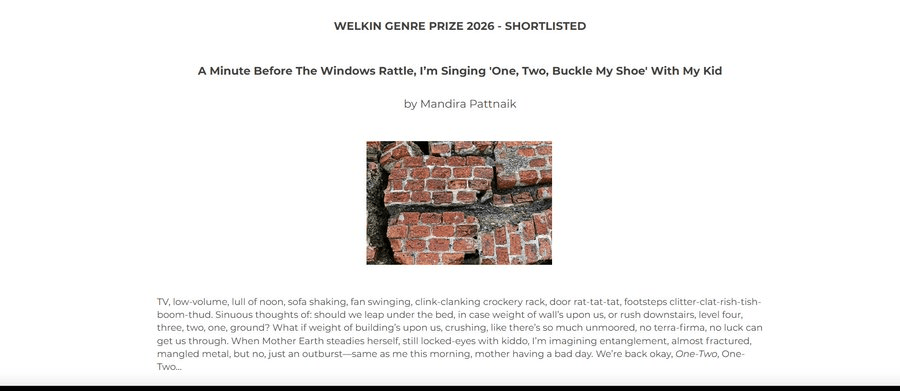
Lastly, I missed mentioning this last month. A mild earthquake did actually happen, which inspired this story! Glad Welkin Genre Prize for micro-length work shortlisted it, and published it on July 24!
Pro-tip
“The highest form of peace is having no desire to be seen, validated or understood by anyone.”
— Epictetus
After my Wigleaf Top 50 longlisting this year, I realized I’ve never been published in the mother magazine Wigleaf. Nor in Smokelong Quarterly. I’ve received quite a few close declines from both. Maybe I didn’t send them the right fit. With this longlisting, six of my stories have made the longlist and two have made the TOP 50. Still…
In any event, I’ve stopped sending out work to about a dozen magazines now. I don’t know if this strategy is permanent or just a phase. I think if a place rejects your work multiple times, it is best to pause a bit and look at other options. Like the quote above, it is often more peaceful than chasing happiness one can’t possibly claim. What is your opinion? Do you have any similar experience?
I’m looking forward to hearing from you!
In case you missed
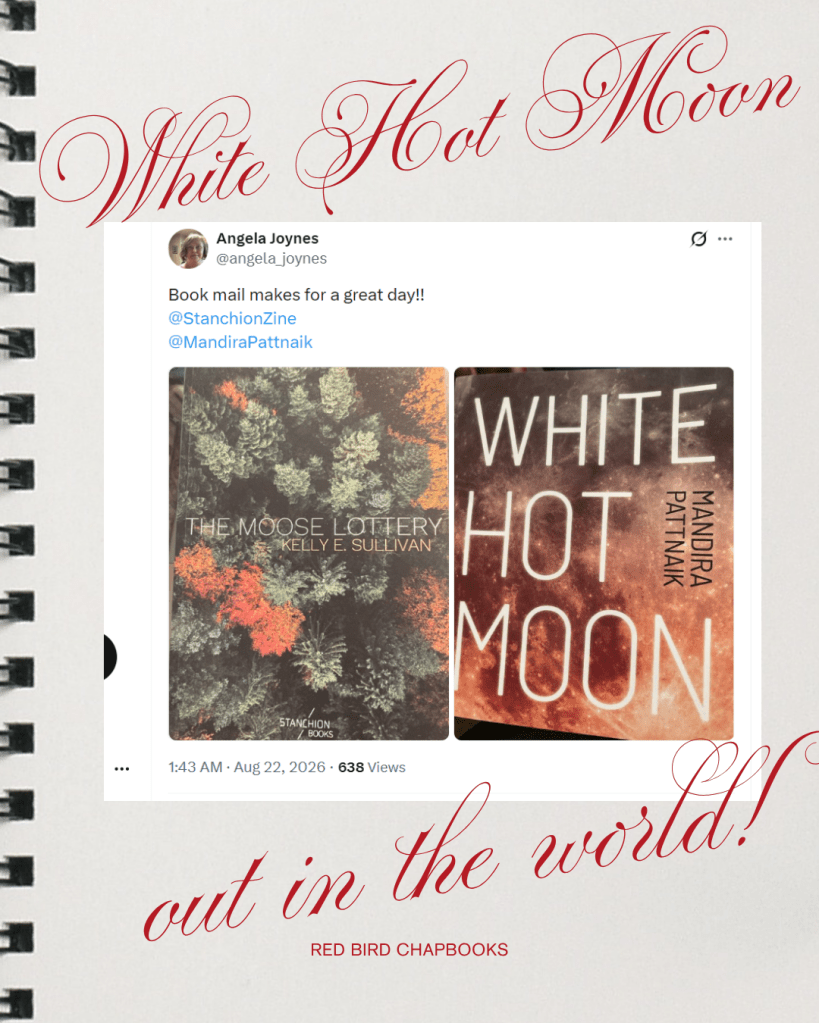
My latest chapbook turned a month-old today. Red Bird Chapbooks is an awesome publisher. They made the first 100 copies entirely by hand using the services of a group of dedicated volunteers. As a press with a 15 year old history, their commitment is unparalleled. Red Bird Chapbooks ran a series of questions/responses around my process and the collection on Facebook. Reader Angela Joynes posted an image of the book and commented: “This book is a work of art” on Facebook–which is truly a overwhelming thing to hear. If you’d like to grab a copy, it’s available EXCLUSIVELY through the press.
thank you!
Thanks a lot for staying with me, and being so supportive! “A Room With a View of One’s Own” has grown, and with it, the website. Stats show that we have already (January-August 2026) registered more visitors and views than the entirety of 2025.
If you have any suggestions on posts you’d like to see, or anything that’d help me improve, please feel free to get in touch.
I’m also looking for guest post articles to be published in November/December. If you have ideas/stories relating to writing life/writing practice, pitch me (in ~100 words) and your words of wisdom could reach 6 continents and 85+ nations! At the moment, publication only, no pay.
Finally, I am offering 50% OFF on MANUSCRIPT CONSULTATIONS for the first 3 spots on a first-come-first-serve basis September 10 onwards until filled.
HAPPY WRITING & ALL GOOD THINGS!
This blog is a monthly newsletter published in the first week that is truly a newsletter–updates from the literary world, open windows, a few personal updates, some tips, opinions and conversations, and a round-up of recent work I truly recommend. If you enjoyed this, please share with your friends. Consider subscribing, commenting and/or liking this post. Thanks!


I’m looking forward to hearing from you!